18-Month-Old Cat Behavior: Understanding Your Young Adult Cat
By CatsOnly Care Team • September 25, 2026
Understanding Your 18-Month-Old Cat's Development and Behavior
Understanding 18 month old Cat behavior starts with seeing this age as part of a broader young adult stage. Many Cats have completed much of their visible body growth by this point, but breed, body size, nutrition, and individual development can affect when physical maturity is reached. Social patterns may still be changing, too. Independence, play intensity, space preferences, or new habits can reflect maturation, but they can also reflect health, stress, resources, relationships, and the home environment.
| Development Area | Kitten and Adolescent Tendencies | Young Adult Tendencies, With Variation |
|---|---|---|
| Physical Development | Many Cats are still growing, with body size, coordination, and muscle tone changing quickly. | Many Cats are near adult size by this stage, though larger Cats and some breeds may continue filling out. |
| Social Confidence | Curiosity, exploration, and sensitivity to new experiences can be high, but personality varies widely. | Some Cats become more selective about contact, routines, and resting places. Others stay highly social and playful. |
| Play Patterns | Predatory play, chasing, pouncing, and grabbing are normal and can be intense. | Predatory play remains normal. Young adults often still need daily interactive play and safe outlets for hunting behavior. |
| Daily Rhythm | Sleep, activity, and feeding routines may feel less settled. | Routines may become easier to predict, but nighttime activity, zoomies, and sudden play bursts can still happen. |
Physical Maturation and Behavior in Young Adult Cats
By 18 months, many Cats are moving through young adulthood, and their daily patterns may look different than they did in kittenhood. An individual Cat may shift how they use space, choose resting spots, seek elevated areas, play, or respond to handling. These behaviors vary widely, so interpret them in the context of that Cat’s history, health, environment, and normal personality.
At 18 months, look for individual patterns in how your Cat uses space rather than assuming a territorial milestone. Your Cat may repeatedly choose a favorite perch, rest in certain rooms, or rub their face on door frames, table corners, and furniture legs. Facial rubbing can leave chemical signals on surfaces. Daily patterns in resting, grooming, play, marking, and social interaction vary by Cat and home environment.
How Young Adult Behavior May Differ from Kittenhood
Earlier kittenhood brings rapid physical growth, learning, exploration, and high levels of play. Our Kitten Prep resources cover early experiences that help shape confidence and social comfort, while remembering that behavior, routines, and learning can still change well beyond kittenhood.
By 18 months, many Cats are moving from rapid kitten growth into young adulthood, but development is still ongoing. Physical maturity varies by Cat and breed, and behavior keeps changing with learning, environment, health, and experience. Compared with earlier kittenhood, you may notice more recognizable patterns in play, rest, social interaction, and how your Cat uses the home.
Understanding Biting and Scratching in Young Adult Cats
When Play Includes Biting, Scratching, or Pouncing
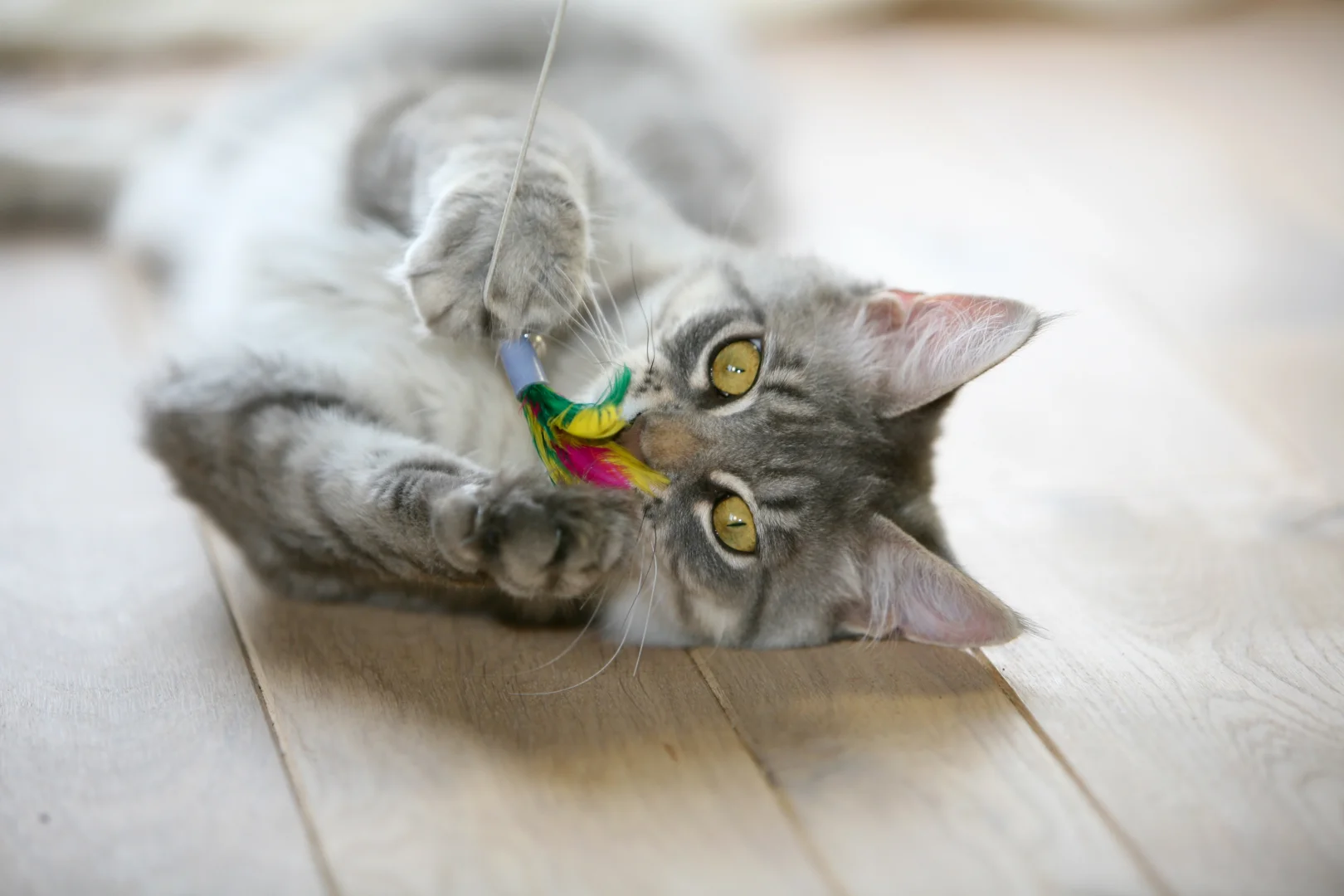
Young adult Cats may have a strong drive to play in ways that include stalking, chasing, pouncing, and catching. Providing appropriate options for interactive and independent play can help direct those behaviors toward wand toys, kicker toys, puzzle feeders, and other safe targets. If biting, scratching, or grabbing happens, look at the full context, since these behaviors are not always play and may also relate to stress, discomfort, overstimulation, or fear.
Watching your Cat’s body language as a whole, and noticing changes during play, can help you pause or adjust the interaction before it keeps intensifying. Consider these observations together, not as one-to-one rules:
- Tail-tip twitching or swishing
- Skin rippling along the back
- Ears rotating sideways or backward
- Sudden freezing in body posture
- Focused, unblinking staring
- Quick head turns toward your petting hand
These are examples of changes a Cat Parent might notice during an interaction, not signs with one fixed meaning. Look at the whole Cat, the context, and what changed from that Cat’s behavior moments before. If your Cat’s body language shifts during petting or play, pause and give them a chance to choose whether to continue.
If play becomes more intense or starts to include biting or scratching, pause the interaction without punishment. Avoid yelling, pushing, or physical correction. Give your Cat space, then offer an appropriate play option when they choose to re-engage, such as a wand toy, soft kicker toy, or other safe outlet. The Feline Veterinary Medical Association also offers feline-specific guidance on playing with your Cat using positive, low-stress methods.
Positive Reinforcement and Redirection Techniques
Punitive reactions are best avoided, since they may confuse or frighten some Cats and rarely teach the behavior you want. Because biting and scratching can have different triggers, use positive reinforcement to reward wanted behaviors and redirection to offer an appropriate outlet.
- Try Clicker Training if It Fits Your Cat : A clicker can mark a specific behavior you want to encourage, followed by a treat, such as choosing to enter a carrier voluntarily.
- Offer Appealing Scratching Options : Provide scratching surfaces with different orientations, textures, and locations, then watch which ones your Cat prefers and uses most often.
- Redirect Teeth and Claws to Toys : If play gets rough, calmly shift the interaction toward an appropriate wand toy, kicker, or other safe outlet for pouncing and grabbing.
- Reinforce Specific Behaviors You Want Repeated : Reward clear, chosen actions, such as using a scratching post, coming when called, or entering the carrier, rather than guessing your Cat's emotional state.
- Create Regular Opportunities for Interactive Play : Use short play sessions to support normal predatory behavior, movement, and enrichment, adapting timing and intensity to your Cat's needs.
Play, Rest, and Environmental Enrichment for Young Adult Cats
Understanding Nighttime Activity in Young Adult Cats
Cats often become more active around dawn, dusk, or overnight, and this can be part of normal feline behavior. Their patterns are flexible, shaped by the individual Cat, household routine, environment, and stimulation. Many Cats also rest for substantial portions of the day, but a new or major sleep or activity change is worth noting.
When nighttime activity disrupts household rest, a predictable evening routine may help your Cat spend energy before the quiet part of the night. Try interactive wand-toy play that lets your Cat stalk, chase, pounce, and catch in a way that matches their interest and stamina. Some Cats prefer short bursts, others need a slower warm-up. If nighttime vocalization, sleep, or activity changes suddenly, a wellness visit through preventative care can help the Care Team evaluate possible discomfort, illness, or metabolic changes.
Vertical Space, Play, and Enrichment
Vertical perches, secure window hammocks, and multi-level Cat trees can expand usable living space while supporting choice. In line with the CatsOnly Five Pillars, offer Safe Spaces and Multiple & Separated Resources, then watch which resting, observing, or climbing options your individual Cat prefers.
Cognitive enrichment gives young adult Cats more opportunities for activity, exploration, play, and problem-solving. When appropriate for your individual Cat, try puzzle feeders, foraging mats, food puzzles, or treat mazes that let them search and work for part of a meal. Toy rotation can also add variety, but watch what your Cat actually chooses, since some Cats prefer familiar favorites over constant novelty.
When a Behavior Change Deserves Veterinary Attention
Young adulthood should not be used to explain away a new or meaningful change in a Cat’s usual behavior. Shifts in activity, appetite, social patterns, litter box habits, or handling tolerance can be clinically meaningful, and may reflect pain, illness, stress, environmental changes, or other factors.
Conditions such as feline lower urinary tract disease, dental pain, gastrointestinal discomfort, or musculoskeletal pain may be associated with changes in behavior, activity, social interaction, elimination, or eating. These observations can have many possible explanations, so the Cat Parent notices the pattern and the veterinarian evaluates what may be contributing to it. Changes a Cat Parent might notice include:
Changes worth discussing with the Care Team include:
- Avoiding the litter box or other litter box habit changes
- New or increased vocalization, especially during quiet hours
- Increased hiding or changes in social interaction
- A new reaction to being touched or handled
- Changes in grooming, including grooming one area more or grooming less
- Immediate veterinary attention: straining to urinate, repeated attempts with little or no urine, or inability to urinate
Before assuming a new behavior is simply part of young adult development, watch for changes that are new, persistent, significant, or concerning, then discuss them with the Care Team so the veterinarian can evaluate possible medical contributors. Cat Parents preparing for that conversation can review our guide on Cat Behavior Prep to see how tracking daily habits, appetite, and litter box patterns gives the Care Team useful context. At CatsOnly, medical causes are considered first, while environmental and behavioral support remain the foundation of care, before or alongside medication when clinically indicated.
Frequently Asked Questions About Young Adult Cat Development
How does a Cat’s behavior change as they reach young adulthood?
Behavior often changes as a Cat moves from kittenhood into young adulthood, but there is no single age when every Cat reaches a finished behavioral or emotional state. Physical maturation also varies by individual Cat and breed. Temperament, learning, environment, health, and lived experience all shape how an 18-month-old Cat behaves.
Why is my young adult Cat interacting with me differently?
Cats show social connection in different ways. One Cat may choose your lap, while another may rest nearby, follow you room to room, or seek shorter interactions. A change in interaction style does not, by itself, show how your Cat feels about you. Sudden avoidance, increased hiding, or behavior outside their usual pattern is worth sharing with the Care Team.
How much play and activity does a young adult Cat need?
An 18-month-old Cat benefits from regular chances for interactive play, movement, exploration, and food-based enrichment, adjusted to their preferences, health, and response. Wand toys, toy-based chase play, and food puzzle foraging can encourage natural behaviors such as stalking, chasing, pouncing, catching, and problem-solving without forcing a one-size-fits-all routine.
Conclusion
At 18 months, your Cat is still growing into their adult behavior. By noticing their individual preferences, offering vertical space, play, enrichment, food puzzles, and positive reinforcement, you support natural feline behaviors while staying alert to new or meaningful changes that deserve attention.
If you notice sudden or meaningful behavior changes, new or increased vocalization, or litter box changes, our Care Team is here to support you. Contact CatsOnly through our services page so a veterinarian can evaluate what may be contributing to the change.
This article is for educational purposes and reflects general feline health information. It is not a diagnosis and does not replace an examination by a veterinarian who knows your Cat. Every Cat is an individual, and recommendations can change with age, history, and physical findings. If you notice a change from your Cat's normal baseline, or you have questions about your Cat's health, contact your veterinary Care Team. If your Cat is struggling to breathe, unable to urinate, or collapsed, seek veterinary care immediately.

Veterinary care designed entirely for Cats.
Most clinics accommodate Cats. We were built for them.
SHARE THIS ARTICLE:
Latest Articles